
The Daimler Ferret Armoured Car is one of the most recognized British military reconnaissance vehicles developed during the Cold War. Built for speed, mobility, and protection, it became a trusted vehicle for the British Army and many other armed forces around the world. Although it was never designed to fight heavy tanks, its ability to gather intelligence and patrol dangerous areas made it an important part of military operations for decades.
Today, the Daimler Ferret Armoured Car remains popular among military historians, collectors, and museums. Its rugged design, dependable performance, and long service history have helped it earn a lasting reputation as one of Britain’s most successful scout vehicles.
A Brief History
The Daimler Ferret Armoured Car was developed in the late 1940s after the Second World War. British military planners wanted a modern replacement for the famous Daimler Dingo Scout Car, which had served with distinction during the war. Daimler was given the task of creating a new vehicle that could provide better protection while keeping the speed and agility needed for reconnaissance missions.
Production officially began in 1952 and continued until 1971. During this period, more than 4,400 vehicles were built. Many Daimler Ferret Armoured Car examples entered service with the British Army, while others were exported to countries across Europe, Africa, Asia, and the Middle East. Its wide adoption proved the vehicle’s reliability and versatility in different climates and operating conditions.
Designed for Reconnaissance
Unlike heavily armed combat vehicles, the Daimler Ferret Armoured Car was built with reconnaissance in mind. Its primary role was to move ahead of larger military units, observe enemy positions, and report valuable information without becoming involved in direct combat whenever possible.
The Daimler Ferret Armoured Car’s compact dimensions allowed it to travel through narrow roads, forests, and rough terrain with ease. The low profile also helped reduce visibility, making it easier for crews to carry out scouting missions while remaining concealed.
| Specification | Details |
|---|---|
| Vehicle Name | Daimler Ferret Armoured Car |
| Also Known As | Ferret Scout Car (FV701) |
| Manufacturer | Daimler Company, United Kingdom |
| Vehicle Type | Light Armoured Reconnaissance Vehicle |
| Country of Origin | United Kingdom |
| Production Years | 1952–1971 |
| Total Built | Over 4,400 units |
| Crew | 2–3 personnel (depending on variant) |
| Engine | Rolls-Royce B60 6-cylinder petrol engine |
| Top Speed | Approximately 58 mph (93 km/h) |
| Operational Range | Around 190 miles (305 km) |
| Weight | Approximately 3.7 tonnes |
| Primary Role | Reconnaissance, Patrol, and Scout Missions |
| Armament | Light Machine Gun (varies by model) |
| Current Status | Retired from military service; popular in museums and private collections |
Performance and Engineering
One of the strongest features of the Daimler Ferret Armoured Car was its dependable engineering. It was powered by a Rolls-Royce B60 six-cylinder petrol engine producing around 130 horsepower. Combined with permanent four-wheel drive, the vehicle offered impressive off-road capability for its time.
The Daimler Ferret Armoured Car could reach speeds of approximately 58 miles per hour (93 km/h) on roads while maintaining good control across uneven ground. Its independent suspension improved comfort for the crew and allowed the vehicle to remain stable during challenging terrain. The transmission system also enabled quick movement in reverse, which could be valuable when withdrawing from dangerous situations.
Protection and Armament
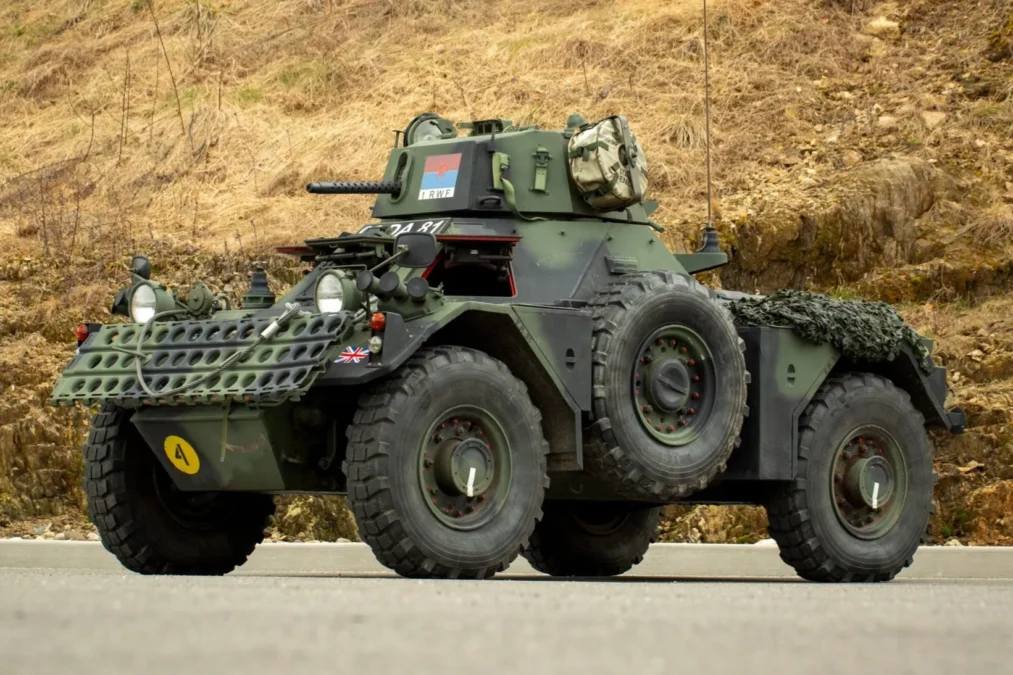
Protection was an important consideration in the Daimler Ferret Armoured Car’s design. Welded steel armour shielded the crew from small-arms fire and shell fragments, offering greater safety during reconnaissance missions. Although the armour was not intended to withstand heavy anti-tank weapons, it provided a good balance between protection and mobility.
Most Daimler Ferret Armoured Car versions carried a light machine gun mounted either openly or within a rotating turret, depending on the variant. Later models received upgraded weapon systems and improved observation equipment. Since the vehicle’s purpose was intelligence gathering rather than offensive combat, its armament remained relatively light compared with larger armoured vehicles.
Variants and Improvements
Several versions of the Daimler Ferret Armoured Car were introduced throughout its production life. Early models featured an open-top design that gave the crew excellent visibility, while later variants added enclosed roofs and rotating turrets for increased protection.
Some Daimler Ferret Armoured Car variants were equipped with anti-tank missile systems or modified for command and communication roles. These improvements allowed the vehicle to adapt to changing military requirements while maintaining its core reconnaissance function.
Service Around the World
The Daimler Ferret Armoured Car served with the British Army for many years and was also purchased by dozens of other nations. It took part in peacekeeping operations, border patrols, training exercises, and internal security duties across different regions of the world.
Its simple mechanical design made maintenance relatively straightforward, which helped extend its operational life. In several countries, Ferret vehicles remained in service long after Britain retired them, highlighting their durability and dependable performance.
A Popular Collector’s Vehicle
Even after leaving military service, the Daimler Ferret Armoured Car continues to attract interest from collectors and restoration enthusiasts. Many surviving vehicles have been carefully restored to their original condition and can now be seen at military museums, historical exhibitions, and classic vehicle events.
Collectors appreciate the vehicle for its authentic military heritage, solid engineering, and historical importance. Restored examples offer visitors a glimpse into Cold War military technology and the evolution of British reconnaissance vehicles.
Lasting Legacy
The Daimler Ferret Armoured Car remains an excellent example of practical military engineering. Rather than relying on heavy weapons, it focused on speed, mobility, and reliability to complete reconnaissance missions effectively. Those qualities allowed it to serve successfully for decades in different environments around the world.
Today, the Ferret is remembered not only as a dependable scout vehicle but also as an important part of Britain’s military history. Its continued presence in museums and private collections ensures that future generations can appreciate its contribution to reconnaissance operations and armoured vehicle development.
Final Thought
The Daimler Ferret Armoured Car stands as a reminder that effective military vehicles do not always need to be large or heavily armed. Its success came from a careful balance of speed, protection, and practicality, qualities that made it valuable in both wartime and peacetime service. More than just a machine, the Ferret represents an important chapter in British armoured vehicle history and continues to be admired for the role it played in shaping modern reconnaissance design.
