
Rytex Gundogs is closely associated with Ian and Wendy Openshaw and with some of the most successful working gundog careers in modern British field trialling. Based at Peplow near Market Drayton in Shropshire, the kennel combines breeding, training and competition rather than treating them as separate activities.
That distinction matters if you are researching Rytex as a potential source of a working dog or simply trying to understand why the name appears so often in pedigrees. Championship results tell only part of the story. The more useful question is what those results reveal about breeding, training and the qualities expected from a serious working gundog.
A kennel built around working performance
Rytex Gundogs describes its work in straightforward terms: selectively bred dogs are handled for the Openshaws themselves and for clients, with training programmes available at different stages of a dog’s development. The kennel has worked with Cocker Spaniels, Springer Spaniels and Labradors.
For someone buying a working dog, that range is significant. A field trial pedigree is not automatically the right choice for every owner. A dog bred for competitive work may have considerable drive, stamina and hunting ability, but those traits also require appropriate training and outlets.
This is one reason the Rytex Gundogs model is worth looking at as more than a list of championship wins. The kennel’s training programme starts with practical foundations such as sit and stay, whistle responses, heelwork, steadiness and retrieving. Advanced work includes handling a dog onto blinds, rabbit-pen steadiness and experience in the shooting field.
Ian and Wendy Openshaw are central to the story
The Rytex Gundogs name is inseparable from Ian and Wendy Openshaw. Ian has built a long career as a breeder, trainer and competitor, while Wendy has also handled and trained championship-winning dogs.
Rytex’s own records document a long list of Field Trial Champions associated with Ian. The published list includes dogs such as Rytex Rapeds, Rytex Rupture, Rytex Ringo, Rytex Rizzle, Mallowdale Diamond, Endowood Cork and Delphaven Domino, among many others.
Independent coverage also places the Openshaws among the most accomplished names in the sport. Gundog Journal included Ian Openshaw among its 2026 Gundog Trainer of the Year finalists and reported more than 130 Field Trial Champions associated with his career.
The exact total can vary depending on when records are counted and how achievements are described, so a published number should always be tied to a dated source. That is preferable to presenting a changing career total as a permanent figure.
The championship record explains the reputation
Rytex says Ian and Wendy have won the Any Variety Spaniel Championship seven times, including six British wins and one Irish win. The kennel also states that Ian has won the Cocker Spaniel Championship four times, with Wendy winning it with Chyknell Megan.
Those results are important because field trial success is not simply a matter of having a well-bred dog. A championship campaign tests the partnership between dog and handler under demanding conditions. The dog needs to hunt effectively, respond to its handler and remain controlled while working in a competitive environment.
Rytex’s champion records provide useful examples of that progression. Some dogs reached Field Trial Champion status after relatively short competitive careers, while others built their records over several seasons.
For readers studying pedigrees, this is a useful reminder: a famous kennel name can tell you something about a dog’s working background, but it should not be treated as a guarantee of quality. The individual dog’s temperament, health, conformation, natural ability and training still need to be considered.
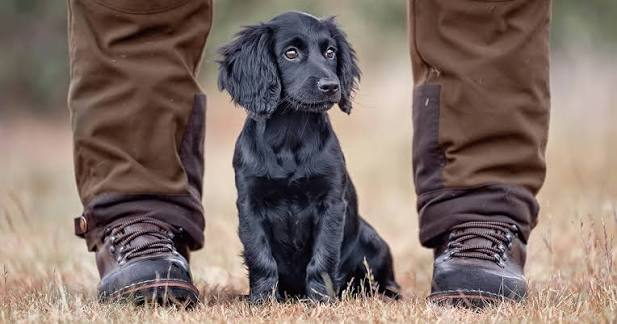
What does Rytex training actually involve?
The published training programme gives a clearer picture than promotional descriptions alone. Basic work includes whistle control, off-lead heelwork, steadiness to a thrown dummy and retrieving both cold and warm game. Advanced training builds on those foundations with blind retrieves, rabbit-pen work and exposure to the shooting field.
That sequence makes practical sense. A dog cannot be expected to handle complicated retrieves reliably if it has not first learned to stop, return and respond to its handler. Likewise, steadiness is not something that can simply be switched on when a dog reaches a shooting field.
For a new handler, the lesson is useful even if they never train at Rytex. Build control before adding complexity. Keep the dog enthusiastic about working, but make sure the response to the handler remains reliable. Training should progress according to the individual dog rather than an arbitrary timetable.
Rytex has also been associated with placeboard training. Sporting Saint says Ian and Wendy have provided feedback and product ideas connected with its placeboards and other training equipment.
The bloodlines have influence beyond Britain
Rytex’s influence can also be seen through breeding connections outside the UK. Sporting dog programmes overseas have used dogs and genetic material connected with the Openshaw lines.
For example, Bullock Creek Springers in New Zealand records the use of frozen semen from FTCh Hollydrive Kurt from Rytex Gundogs in its breeding programme.
There is also a useful historical example involving English Cocker Spaniels. Purina Pro Club reported on Ryglen Gundogs and described how its founder imported an English Cocker from Ian Openshaw after seeing the dogs work in Britain.
These examples show how influential working bloodlines can travel. They also highlight an important point for prospective breeders: importing a successful pedigree does not reproduce the original kennel’s results by itself. Breeding decisions still require attention to health, temperament, structure, working ability and compatibility between sire and dam.
Choosing a Rytex-bred or related working dog
Anyone considering a puppy from a Rytex-related line should look beyond the kennel name.
Start by asking what the dog is intended to do. A competitive field trial prospect has different requirements from a dog primarily intended for picking up, beating or active family life. The more demanding the intended work, the more important it becomes to understand the parents’ actual working characteristics.
It is also sensible to ask for details about the parents rather than relying on championship titles alone. Look at their working records, temperament, health information and the type of work they have been used for. A pedigree should be a starting point for questions, not the answer to all of them.
For less experienced owners, training support may be just as important as breeding. A highly driven spaniel can be rewarding, but without suitable exercise and consistent training, that drive can become difficult to manage.
Why Rytex remains relevant in 2026
The Rytex story is not based solely on older championship records. Ian Openshaw was included in the 2026 Gundog Trainer of the Year finalists, with Gundog Journal highlighting his championship record and international reputation.
At the same time, the kennel continues to present breeding, training and competition as connected parts of its work. That combination is perhaps the most useful way to understand the Rytex name.
For enthusiasts, the appeal is the proven working record. For breeders, the pedigrees provide lines with substantial field trial history. For handlers, the training philosophy offers a practical example of how basic control can be developed into advanced working skills.
Final perspective
Rytex Gundogs is best understood through the relationship between breeding, training and competition. Ian and Wendy Openshaw have spent decades developing that combination, while the kennel’s championship records provide evidence of sustained success.
For anyone researching the name, the most useful approach is to look past the reputation and examine the individual dog, its parents, working record, health and intended role. That gives a much clearer picture of whether a particular Rytex-related line is genuinely suitable for the job.
FAQs
Q: What is Rytex Gundogs known for?
A: Rytex Gundogs is known for breeding and training high-quality working gundogs.
Q: Who runs Rytex Gundogs?
A: Ian and Wendy Openshaw run Rytex Gundogs in Shropshire, England.
Q: Which breeds are linked with Rytex Gundogs?
A: Rytex Gundogs is especially linked with Cocker Spaniels, Springer Spaniels and Labradors.
Q: Where is Rytex Gundogs based?
A: Rytex Gundogs is based near Market Drayton in Shropshire.
Q: Why are Rytex bloodlines respected?
A: Rytex bloodlines are respected for strong field trial and working performance.
